Philippines Population Pyramid 2015
Philippines in 2015
The population of the Philippines in 2015 was 105,312,992. That is 19.7% more than in 2005, when the population stood at 88,015,962.
The median age was 23.3 years, and for every 100 people of working age (15–64) there were 53.5 children under 15 and 6.0 people aged 65 or over. The pyramid is expansive: its wide base of young cohorts reflects high fertility and a rapidly growing population.
Data source: United Nations World Population Prospects, 2024 revision (medium variant) — last updated July 2024.
In 2023 women in the Philippines had on average 1.92 children, below the replacement level of 2.1.
Source: World Bank World Development Indicators, latest available year.
A child born there in 2023 could expect to live 69.8 years on average (72.8 years for girls, 66.9 for boys).
Source: World Bank World Development Indicators, latest available year.
68,921 immigrants live in Philippines, 0.1% of the population.
| China | 27,676 |
| India | 19,801 |
| United States of America | 6,469 |
| Republic of Korea | 4,520 |
| Japan | 4,492 |
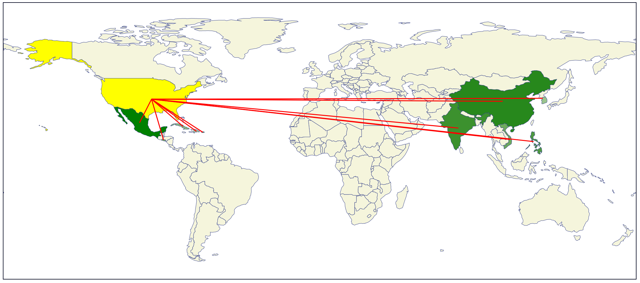
6,967,274 people born in Philippines live in other countries.
| United States of America | 2,263,697 |
| Canada | 835,779 |
| Saudi Arabia | 755,432 |
| United Arab Emirates | 528,527 |
| Australia | 356,833 |
Source: United Nations International Migrant Stock 2024.
| Country | Population | Median age | Relative size |
|---|---|---|---|
| Philippines | 105,312,992 | 23.3 | |
| Viet Nam | 92,823,254 | 30.2 | |
| Thailand | 70,540,796 | 36.8 | |
| Myanmar | 51,089,056 | 28.3 | |
| Malaysia | 31,232,798 | 27.8 |