India Population Pyramid (1950–2100)
India in 2026
The population of India in 2026 is estimated at 1,476,625,576. A decade earlier, in 2016, the population was 1,343,944,296; it has grown by 9.9% since.
Half of the population is younger than 30.2 years; 23.8% are children under 15 and 7.6% are 65 or older. The pyramid is stationary: cohort sizes are roughly even through the younger ages, reflecting fertility close to replacement level and slow population change.
Data source: United Nations World Population Prospects, 2024 revision (medium variant) — last updated July 2024.
In 2023 women in India had on average 1.98 children, below the replacement level of 2.1.
Source: World Bank World Development Indicators, latest available year.
A child born there in 2023 could expect to live 72.0 years on average (73.6 years for girls, 70.5 for boys).
Source: World Bank World Development Indicators, latest available year.
4,346,401 immigrants live in India, 0.3% of the population.
| Bangladesh | 2,293,959 |
| Pakistan | 768,138 |
| Nepal | 663,518 |
| Sri Lanka | 253,869 |
| Myanmar | 132,598 |
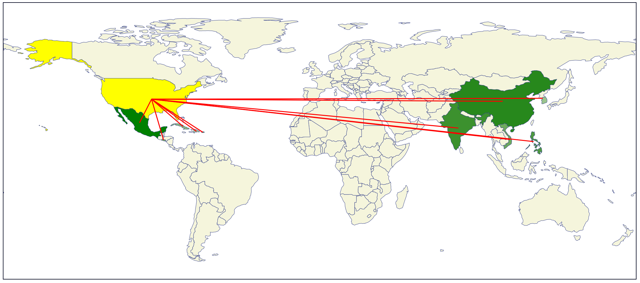
18,531,439 people born in India live in other countries.
| United Arab Emirates | 3,248,545 |
| United States of America | 3,165,238 |
| Saudi Arabia | 1,953,496 |
| Pakistan | 1,597,134 |
| Kuwait | 1,231,094 |
Source: United Nations International Migrant Stock 2024.
| Country | Population | Median age | Relative size |
|---|---|---|---|
| India | 1,476,625,577 | 30.2 | |
| Pakistan | 259,299,792 | 21.8 | |
| Bangladesh | 177,818,045 | 27.3 | |
| Iran | 93,168,498 | 35.5 | |
| Afghanistan | 45,047,069 | 18.5 |