Japan Population Pyramid 2020
Japan in 2020
The population of Japan in 2020 was 126,304,543. That is 1.5% less than in 2010, when the population stood at 128,185,275.
With a median age of 48.7 years, Japan had a youth dependency ratio of 20.8 and an old-age dependency ratio of 49.1 per 100 people of working age. The pyramid is constrictive: cohorts of children are smaller than those of their parents, reflecting low fertility and an ageing population.
Data source: United Nations World Population Prospects, 2024 revision (medium variant) — last updated July 2024.
In 2023 women in Japan had on average 1.20 children, below the replacement level of 2.1.
Source: World Bank World Development Indicators, latest available year.
Life expectancy at birth was 84.0 years in 2023: 87.1 for women and 81.1 for men.
Source: World Bank World Development Indicators, latest available year.
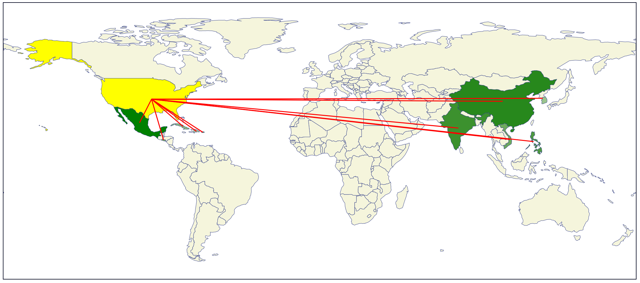
3,409,328 immigrants live in Japan, 2.8% of the population.
| China | 809,893 |
| Viet Nam | 589,874 |
| Republic of Korea | 393,944 |
| Philippines | 319,772 |
| Brazil | 207,220 |
1,007,411 people born in Japan live in other countries.
| United States of America | 547,444 |
| Thailand | 104,515 |
| Australia | 53,094 |
| Brazil | 52,758 |
| China | 40,436 |
Source: United Nations International Migrant Stock 2024.
| Country | Population | Median age | Relative size |
|---|---|---|---|
| Japan | 126,304,543 | 48.7 | |
| Republic of Korea | 51,858,482 | 43.8 | |
| Dem. People's Republic of Korea | 26,136,312 | 36.4 | |
| Taiwan | 23,663,459 | 42.8 | |
| China, Hong Kong SAR | 7,490,236 | 45.4 |