Europe Population Pyramid 2016
Europe in 2016
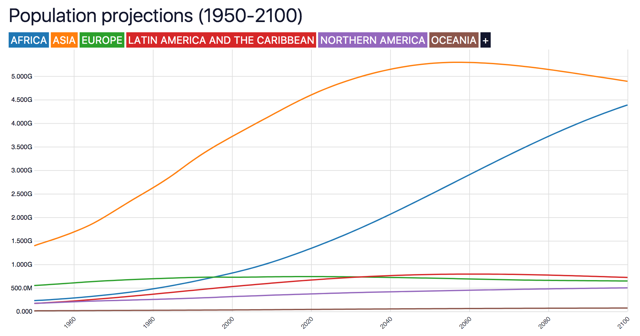
In 2016, Europe had a total population of 746,003,108 people. Over the previous ten years the population grew by 1.8%, up from 732,684,068 in 2006.
With a median age of 41.6 years, Europe had a youth dependency ratio of 24.0 and an old-age dependency ratio of 26.9 per 100 people of working age. The pyramid is constrictive: cohorts of children are smaller than those of their parents, reflecting low fertility and an ageing population.
Data source: United Nations World Population Prospects, 2024 revision (medium variant) — last updated July 2024.
The World Bank does not publish this indicator for regions or continents.
The World Bank does not publish this indicator for regions or continents.
83,280,495 immigrants live in Europe.
| Ukraine | 8,703,691 |
| Russian Federation | 6,189,503 |
| Romania | 4,159,352 |
| Poland | 3,919,956 |
| Morocco | 3,272,343 |
60,833,587 people born in Europe live in other countries.
| Germany | 8,559,326 |
| United States of America | 4,690,040 |
| Ukraine | 3,844,198 |
| United Kingdom | 3,682,751 |
| Russian Federation | 3,479,735 |